FlowPredictor 2026
About Our Project
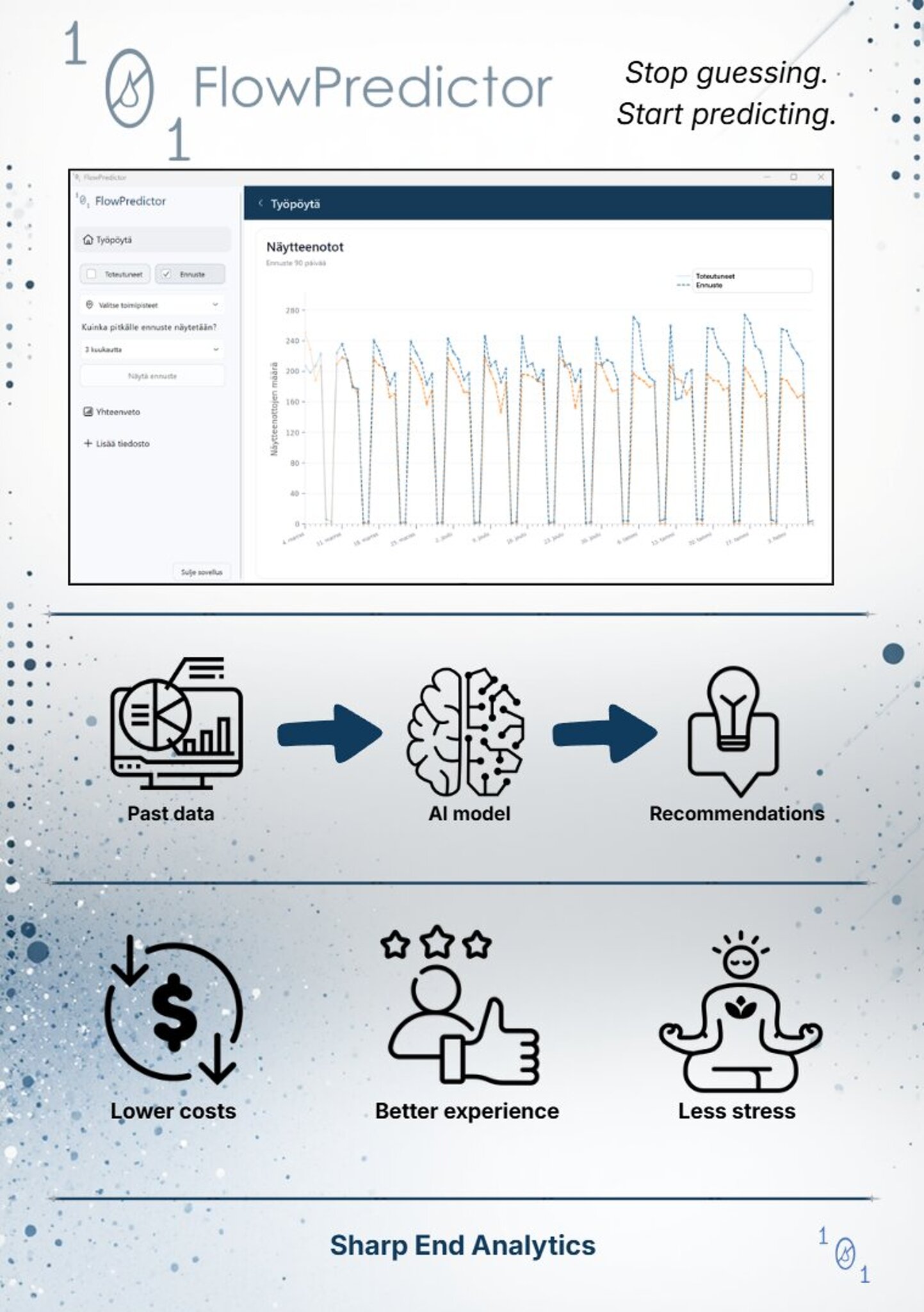
We, team Sharp End Analytics, have developed a tool for predicting and visualizing patient flow in collaboration with Varha’s (local wellbeing services in Southwest Finland) phlebotomy units. The goal of our project was to utilize historical data on the number of patients in different units at different times and use that information to create an easy-to-use visualization tool to support shift planning. All of this is made possible through FlowPredictor.
With FlowPredictor, organizations can easily visualize historical data in numerical and graphical formats, in addition to being able to view future predictions. The application provides several metrics that help organizations better understand their resource distribution and support more informed decisions about future resource allocation.
By using FlowPredictor, organizations can utilize their existing resources more efficiently.
Advantages
One of the greatest advantages of FlowPredictor is its ability to help organizations use their human resources as efficiently as possible. Personnel costs represent a significant portion of many organizations’ overall expenses, and FlowPredictor has the potential to reduce these costs.
When resources are allocated efficiently, customer experience also improves. Additionally, a more balanced distribution of personnel reduces employees’ workload, as staff can be allocated more easily to units with higher patient demand.
With FlowPredictor, organizations can reduce unnecessary personnel costs, improve customer experience, and lessen the workload on employees.
Results
With FlowPredictor, we address the challenge of unpredictable patient flow. We developed the software in close collaboration with Varha, ensuring that the needs of the end users remained central throughout the development process.
Our project was inspired by a real-world problem, and through our work we have created a practical solution to address it.
Future Development
Our team will continue working on FlowPredictor after the course ends. We are inspired by the work we have done and see strong potential for the solution to help solve patient flow challenges in other organizations as well.
In the future, we aim to improve FlowPredictor’s usability and the accuracy of its predictions. We also plan to integrate additional features into the system, including demographic information and more advanced metrics.
Technologies Used
We primarily developed FlowPredictor using the Python programming language. The predictions are generated using a machine learning algorithm, and the data used by FlowPredictor is managed using SQL.